
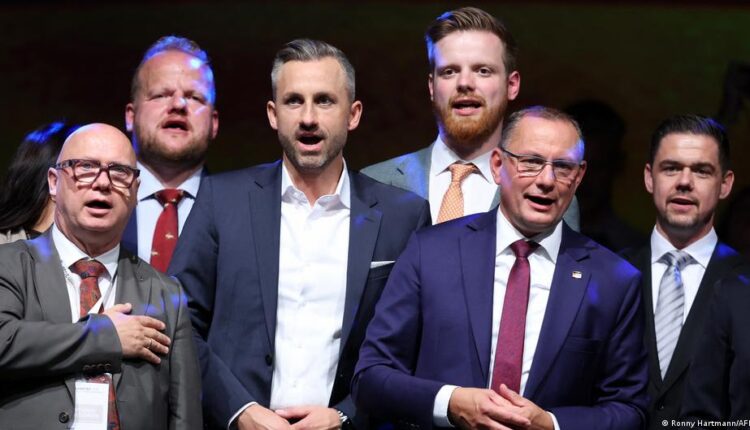
Far-Right Alternative for Germany Party Dominates Saxony-Anhalt Elections
TL/DR –
The far-right populist Alternative for Germany (AfD) emerged as the strongest party in Saxony-Anhalt’s recent election, narrowly missing an absolute majority. The party aimed to rule alone to avoid compromising its agenda, which includes compulsory work for asylum-seekers and the abolition of public funding for democracy programs. AfD is reportedly hoping to attract disillusioned conservative voters rather than partnering with other parties, despite internal tensions and public skepticism.
AfD Emerges as Saxony-Anhalt’s Dominant Party
The far-right Alternative for Germany (AfD) emerged as the strongest party in Saxony-Anhalt’s state parliament with nearly 44% votes. AfD’s agenda includes compulsory work for asylum-seekers and abolition of funding for democracy programs.
AfD’s Anti-Agenda Against Political Rivals
AfD consistently alleges its rivals as criminal organizations. According to Teresa Haussmann of the University of Potsdam, the party sees all other parties as a part of a political elite and that must be opposed.
Ulrich Siegmund: ‘No compromises!’
Post elections, AfD’s lead candidate, Ulrich Siegmund, stated that the party would not compromise on its principles. AfD continues to target its political opponents with inflammatory rhetoric.
AfD’s Prospective Power-Sharing Partners
Potential coalition partners include the conservative Christian Democrats (CDU) and the populist Sahra Wagenknecht Alliance (BSW).
AfD’s Harsh Remarks on CDU and BSW
Soon after the victory, AfD’s Alice Weidel lashed out at CDU/CSU for their poor electoral performance. In contrast, AfD targets disillusioned conservatives whilst maintaining its radical rhetoric. Furthermore, AfD’s confrontational stance towards BSW was evident when Kirchner referred to a BSW politician as a “half-Italian.”
AfD’s National Leadership Aspires to Govern
AfD’s plan to govern on its own or induce upheaval in competing parties is clear. Party strategist Torben Braga and other leading figures openly talk about CDU’s destruction as a political objective. If this does not lead to an AfD-led government, the party might push for another election.
However, political scientist Haussmann opines that AfD’s co-leader Weidel, with aspirations of becoming the chancellor, would not welcome this prospect. Despite its electoral wins, AfD continues to face substantial public skepticism and internal discord.
—
Read More US Political News