
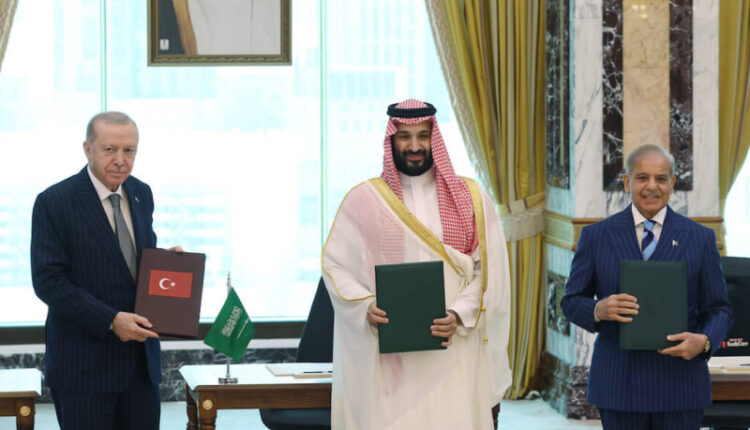
Mecca Joint Defense Agreement: A Shift in Middle East and South Asia Security
TL/DR –
The Mecca Joint Defense Agreement, signed by Turkey, Saudi Arabia, and Pakistan on August 7, 2026, changes the security dynamic between the Middle East and South Asia by stating that an armed attack against one of the nations would be considered an attack against all three. Each nation brings diverse strengths to the agreement: Turkey has NATO’s second-largest military force, Pakistan is the only nuclear-armed Muslim country, and Saudi Arabia has significant financial resources and influences in Gulf geopolitics. The agreement reflects a shift away from dependence on non-regional powers, like the U.S., for security and towards a multi-layered regional security structure.
The Mecca Joint Defense Agreement: A New Security Paradigm
The Mecca Joint Defense Agreement, inked on August 7, 2026 by Turkey, Saudi Arabia, and Pakistan, represents a major shift in the security landscape between the Middle East and South Asia. An armed aggression towards any member is treated as an attack against all three nations, transcending common defense cooperation to forge a new security mechanism founded on collective deterrence.
What makes this agreement particularly noteworthy in global relations is the unification of diverse power dynamics within a single security framework. Turkey boasts NATO’s second largest military, advanced operational capabilities and a robust defense industry. Pakistan is the only Muslim state with nuclear weapons, while Saudi Arabia’s influence lies in its immense energy resources, fiscal prowess and geopolitical weight in the Gulf. Hence, the Mecca Agreement signifies a unique combination of strategic capabilities, contrasting a typical military alliance.
The International Context and Strategic Autonomy
The international milieu that gave birth to this agreement bears importance. Escalating military tensions in the Middle East, security of energy transportation routes, Iran-centric conflict dynamics, and the urge for regional states to diversify their security provisions indicate a quest for a fresh regional security order. The Mecca Agreement manifests the desire of regional states to depend more on self-established security systems, instead of external guarantees.
The concept of strategic autonomy is crucial in this scenario. Post Cold War, the US military presence and bilateral security ties have been key components of the Middle Eastern security framework. While the Mecca Agreement does not abolish this system, it is clear that prior bilateral or multilateral obligations remain in effect. Nonetheless, the accord expresses regional actors’ will to develop their own deterrence mechanisms alongside the Washington-centric security model, indicating a shift from reliance on a sole security center to a multi-layered security architecture.
—
Read More US Political News